The Status Game: On Social Position and How We Use It by Will Storr
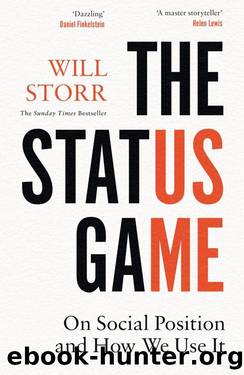
Author:Will Storr [Storr, Will]
Language: eng
Format: epub, mobi, azw3
ISBN: 9780008354657
Google: RqL6DwAAQBAJ
Amazon: B08H7Y414K
Barnesnoble: B08H7Y414K
Publisher: William Collins
Published: 2021-09-01T23:00:00+00:00
23
Annihilation Part Two
WHEN A GAME becomes tight, so does the story it tells of the world. It looks at the hierarchy â at where it sits versus its rivals â and conjures a simplistic, self-serving, moralistic tale that explains how that hierarchy came to be. This story is always the same: weâre the virtuous players, deserving of more, and those who block our path are evil. The story is seductive: itâs what players want to believe. It becomes a source of status and of hope for more status, and of resentment â an almighty resentment, the rage of the gods â thatâs aimed at the enemy. It is a sacred story. Everyone must believe it in every detail. As the cousins run rampant, threatening and enforcing, we can be swept into it, a leaf in the torrent. The narrative becomes more extreme and more deranged. But we keep believing. It feels so real. Weâre dreamers, and the dreams we dream are those of our games. We inhabit them. We enact them. And when dreams turn dark we become their nightmares.
And so our journey into the status game arrives at hell. At an earlier stop, we encountered the disordered interior worlds of individual killers and there discovered powerful currents of grandiosity and humiliation. We found these same currents in the collective dreams of one of historyâs most lethal games. The Nazis were Elliot Rodger, Ed Kemper and Ted Kaczynski. They told a self-serving story that explained their catastrophic lack of status and justified its restoration in murderous attack. But itâs not just Germany thatâs been possessed in this way. Nations the world over become dangerous when humiliated. One study of ninety-four wars since 1648 found 67 per cent were motivated by matters of national standing or revenge, with the next greatest factor â security â coming in at a distant 18 per cent. Anthropologists Professors Alan Page Fiske and Tage Shakti Rai find that frequently, âdecision-makers and public opinion are motivated to declare war to maintain or raise the rank of their nation vis-a-vis other nations, particularly when they feel that they have been unjustly pushed down to a low rank among other nationsâ. The warring party will tend to attack in a dream of toxic morality, convinced of its virtuous intent: âthe more a nation feels humiliated by a moral violation against it, and the more the nation experiences the act as morally outrageous, the more it seeks vengeanceâ.
Grandiosity and humiliation powered the dreams of the young Red Guard warriors who fought the Cultural Revolution in China, during which between 500,000 and two million people were killed. Leader Mao Tse Tung was a notorious narcissist, believing heâd be âthe man who leads planet Earth into Communismâ. But, following a disastrous 1959â1960 famine there emerged signs of rebellion against him. Maoâs party told a story that said his nationâs glorious rise was being undermined by secret capitalists who were plotting to create a âdictatorship of the bourgeoisieâ. The masses were urged
Download
The Status Game: On Social Position and How We Use It by Will Storr.mobi
The Status Game: On Social Position and How We Use It by Will Storr.azw3
This site does not store any files on its server. We only index and link to content provided by other sites. Please contact the content providers to delete copyright contents if any and email us, we'll remove relevant links or contents immediately.
| Anthropology | Archaeology |
| Philosophy | Politics & Government |
| Social Sciences | Sociology |
| Women's Studies |
Born to Run: by Christopher McDougall(7127)
The Leavers by Lisa Ko(6948)
iGen by Jean M. Twenge(5415)
Sapiens by Yuval Noah Harari(5370)
Spare by Prince Harry The Duke of Sussex(5197)
The Kite Runner by Khaled Hosseini(5179)
Machine Learning at Scale with H2O by Gregory Keys | David Whiting(4313)
Bullshit Jobs by David Graeber(4190)
Never by Ken Follett(3957)
Goodbye Paradise(3810)
Livewired by David Eagleman(3773)
Fairy Tale by Stephen King(3398)
A Dictionary of Sociology by Unknown(3085)
Harry Potter 4 - Harry Potter and The Goblet of Fire by J.K.Rowling(3073)
The Social Psychology of Inequality by Unknown(3031)
The Club by A.L. Brooks(2925)
Will by Will Smith(2920)
0041152001443424520 .pdf by Unknown(2845)
People of the Earth: An Introduction to World Prehistory by Dr. Brian Fagan & Nadia Durrani(2736)
